Dressing a Bump for a Long Car Journey
Quick Answer: The constraints are the seatbelt position, the waistband, and temperature control you cannot adjust. Choose a soft high or under-bump waistband with no hard fastening, wear layers you can remove while seated, and pick a top long enough that it does not ride up when you are reclined. The seatbelt goes under the bump and across the hips, never across the middle of it, and the outfit should not interfere with that.
Three hours in a car is not three hours of being out. It is three hours in one position, in a temperature someone else controls, with a belt in a fixed place.
Everything that is slightly annoying at home becomes the main event by hour two.

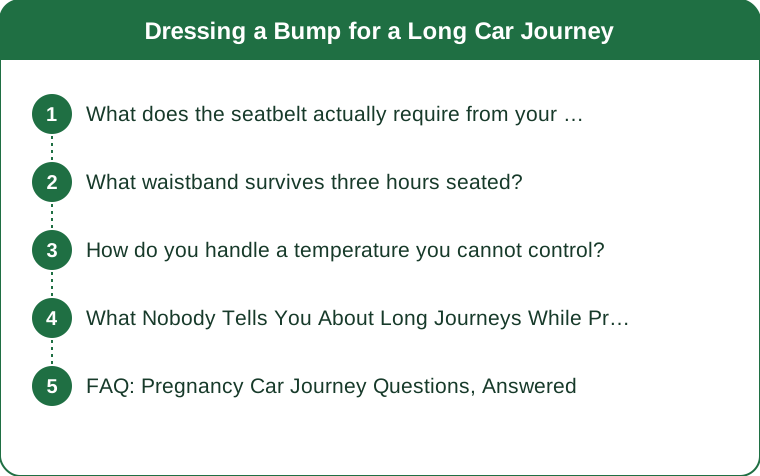
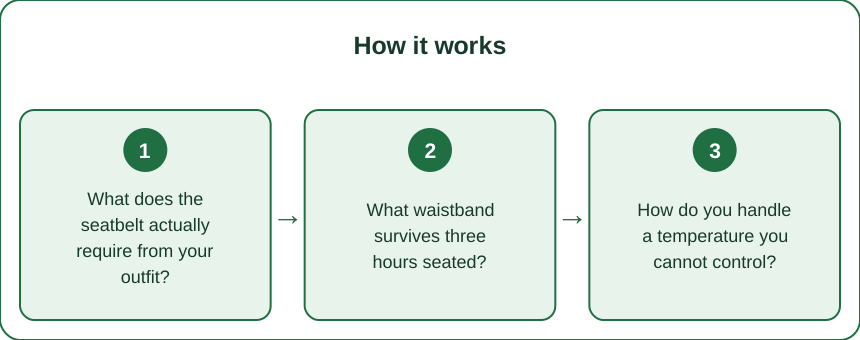
What does the seatbelt actually require from your outfit?
This is the safety point and it comes first.
The lap portion goes under the bump, sitting low across the hips and the tops of the thighs. The shoulder portion goes between the breasts and to the side of the bump. Never across the middle of the bump. This is standard guidance from maternity and road safety organisations, and it matters — the belt should load the pelvis, which is bone, rather than the abdomen.
What this means for clothes:
- Nothing bulky at the hip. A thick waistband, a chunky belt, a big pocket, or a knotted layer at the hip pushes the lap belt up and off the pelvis. A soft flat waistband is what you want.
- No hard fastenings under the belt path. Buttons, studs, and rigid panels sit directly under load for hours and become genuinely painful. This is the most common complaint on long journeys.
- A top that stays put. If your top rides up when you recline, the shoulder belt ends up against bare skin, which is uncomfortable and makes people reposition it badly.
- Layers you can remove while seated. A coat worn under a seatbelt is not recommended anyway — bulky outer layers introduce slack. Take it off before you belt up, which means you need what is underneath to be warm enough.
If you have any concerns about belt positioning, particularly later in pregnancy, ask your midwife. This is general information, not medical advice.
What waistband survives three hours seated?
A soft one that does not sit at your natural waist. Everything else is a variation on that.
Seated for a long period, your abdomen changes shape — you are compressed, you may be bloated, and the position is fixed. A waistband that is comfortable standing can be genuinely painful after ninety minutes in the same seat.
Over-bump panels: the full soft jersey panel is the most comfortable option for most people on long journeys, because it distributes with no edge. The one failure mode is that it can roll down, especially seated. A panel with some depth and a decent weight of fabric rolls less than a thin one.
Under-bump bands: comfortable for many, and better for people who find the panel too warm. The risk is that the band ends up sitting exactly where the lap belt sits, creating a pressure line. If you use under-bump, check that the band and the belt are not stacked.
Side-ruched non-maternity: fine for shorter journeys, less reliable for long ones because the fastening is usually rigid.
What to avoid entirely: jeans with a hard button, anything with a zip under the belt path, and drawstrings that tie in a knot at the front, which becomes a pressure point.
A practical trick: whatever you wear, check it seated in a car before the journey, not standing in front of a mirror. Sit down, do the belt up, and give it two minutes. Most problems announce themselves immediately.

How do you handle a temperature you cannot control?
With layers that come off from the top, and by dressing for the coldest realistic version.
Car temperature is negotiated between everyone in the car, which means it is rarely right for you, and pregnancy commonly makes people feel warmer than usual. Add sun through glass, which can make one side of the car substantially hotter, and a three-hour journey can involve a genuine range.
The structure that works:
- A fitted, breathable base layer. Cotton, bamboo, or a fine merino. This is what you will be wearing for most of the journey and it needs to be comfortable on its own.
- A mid layer that unbuttons or unzips from the front — a cardigan, an overshirt, a zip-up. You can open it without standing up, which is the entire requirement.
- A blanket or large scarf rather than a coat. Far more adjustable than a garment, works over the seatbelt safely, and doubles as lumbar support.
- The coat comes off before you get in. Put it on the back seat.
Two specific details:
Feet. They get cold in footwells and they also swell on long journeys. A shoe you can slip off, plus a warm sock, covers both. Tight shoes at hour three are miserable.
Sun through the side window. A scarf over the shoulder or a window shade is worth having. It is a surprisingly common source of overheating on one side only.
What Nobody Tells You About Long Journeys While Pregnant
You will need to stop more often than the driver expects, and that is normal. General guidance for pregnancy is to break long journeys regularly — roughly every ninety minutes to two hours — to move, stretch, and reduce the risk of blood clots, which is elevated in pregnancy. Plan the stops into the journey time rather than treating them as delays. Ask your midwife about long journeys, especially long-haul or later in pregnancy.
Swelling is worse on long journeys than on long days. Sitting still with your feet down is the specific combination that produces it. Getting out and walking for a few minutes at each stop makes a real difference, and it is far more effective than anything you wear.
Compression socks are genuinely worth considering for long journeys — ask your midwife, since they are commonly recommended in pregnancy for exactly this. Put them on before you leave rather than at a service station.
Bring a small cushion. A rolled jumper behind the lower back changes the whole experience, and the seat that is fine for twenty minutes is often not fine for three hours.
The back seat is not automatically better. More legroom often means a more reclined position, which can be harder on the lower back. If you have a choice, the front passenger seat with the seat moved back and slightly reclined is usually more comfortable, and it is where the belt geometry tends to work best.
Bring food you can eat one-handed. A three-hour journey with pregnancy hunger and no snack is a long three hours, and service station options at 4pm are limited.
FAQ: Pregnancy Car Journey Questions, Answered
Is there a point in pregnancy when long car journeys are not advised?
This depends entirely on your individual circumstances, and it is a question for your midwife or doctor rather than a general article. Many people travel comfortably throughout; some conditions change that advice. Ask before booking anything significant.
Should I use a pregnancy seatbelt adjuster?
These exist and opinions vary. Some maternity organisations are cautious about aftermarket devices because they can alter how the belt performs. The consistently recommended approach is correct positioning of a standard belt — lap portion low under the bump, shoulder portion to the side. Ask your midwife if you are unsure.
What is the best top for a long journey?
Longer than you think, in a fabric with some weight so it does not ride up, and not tight across the bump. A longline fitted top or a soft jersey dress with leggings both work well. Avoid anything cropped, which will end up somewhere unhelpful.
What about the return journey?
Pack a second complete outfit if the trip is more than a day. Comfort tolerance drops as pregnancy progresses and after a few days away, and what felt fine on the outbound leg frequently does not on the way back. This is general information, not medical advice.
TL;DR:
- The seatbelt comes first: lap portion low under the bump across the hips, shoulder portion to the side. Nothing bulky or hard-fastening in the belt path.
- A soft over-bump panel with some weight is the most reliable waistband for a long seated journey.
- Layers that open from the front, plus a blanket rather than a coat. Take the coat off before belting up.
- Shoes you can slip off, warm socks, and a cushion for the lower back.
- Stop roughly every ninety minutes to walk. Ask your midwife about compression socks.
- Test the outfit seated in a car with the belt done up, not standing in a mirror.
Three hours in one position is a different problem from a day out. This is general information, not medical advice.
See It in Motion
Seen here: Maternity Capris with Side Pockets — shop it on bubblelime.com
Keep Reading
This article is for general informational and styling purposes only. Fit, sizing, and product availability may vary.